
Why freeze milk?
Let me preface this guide by saying that you do NOT have to have a freezer stash to feed your baby. AT. ALL. In the breastfeeding community, we have a saying, "Feed the baby, NOT the freezer". Your journey of feeding your baby might include a freezer stash or it might not. Either way is perfect for you and your baby.
There are many reasons for freezing breastmilk. Initially, a lot of moms have an oversupply of milk and are not sure what to do with it. Some donate it to other moms and babies in need. Some sell it. A lot of moms freeze it to save it for later or have a cushion in times of a supply dip. For me, my goal was to freeze enough milk during the first year so I could wean and still feed my kids breastmilk until they were 2 years old. I was able to accomplish this with both kiddos.
Where to start freezing milk?
In my opinion, the best place to start your freezer stash is by utilizing the pitcher method. This method includes pouring all of your pumped milk from a 24-hour period into a pitcher, preparing bottles for the next day, and freezing the excess. Here's what it looks like for me. Starting with my midnight pump on Sunday night through my last pump on Sunday night at 9 pm, I will pump my midnight bottle and put it in the fridge. At my 3 AM pump, I'll pour the cooled milk from the midnight pump into my pitcher. I'll put the bottle of the 3 AM pumped milk into the fridge to cool. I continue this throughout the day until my 9 PM pump. When I get done with my 9 PM pump, I'll pour it into the pitcher.
NOTE: It is advised to cool all milk before pouring it into a pitcher. I do this, except for the last pump of the day because there's so much more cooled milk than freshly pumped. Once all of my milk is combined, I'll pour bottles for Monday for my kiddo and freeze the excess. Once you have your daily surplus established you can begin freezing.
Supplies for Freezing Breastmilk
Freezing breastmilk can get tricky because it can take up so much space in your freezer. Over my 2 journeys of breastfeeding, I think I came up with a pretty good system to get the most out of my freezer space. I could get 72 ounces to a brick. A brick is a gallon baggie of individual bags stored together. Here's what I used to get the most efficient bricks
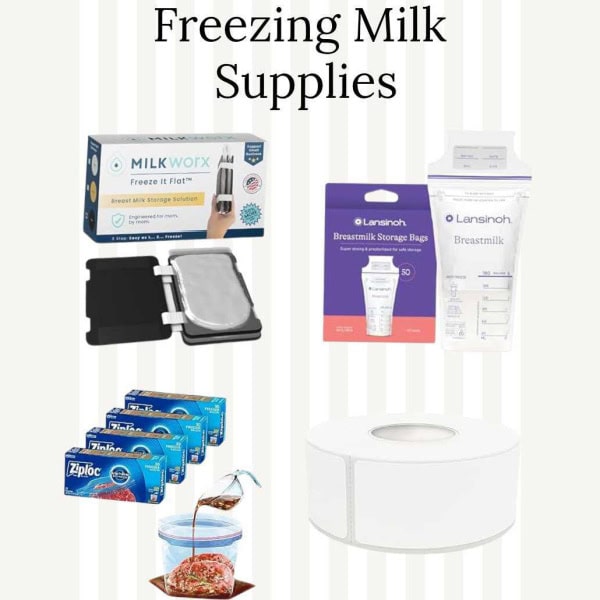
- Lansinoh bags. These sometimes get a bad rap for leaking but I utilize the reverse pitcher method and never had to worry about leaks. These bags, by far, freeze the flattest.
- Freeze It Flats. They envelope your milk bags and allow them to freeze flat, without any wasted space.
- Ziploc Gallon Baggies. I tried several brands and I found this one to hold the most milk.
- Labels. During my first journey, I would just write the date, amount of ounces, and the numbered brick on the baggie with a Sharpie. The second time around I made labels that could be seen through the side. It was much more efficient. If I were to redo it, however, I'd use these freezer labels because it was very difficult to slip the paper into the brick once it was made.
Measuring your Milk
I recommend freezing in 4-ounce increments. As I mentioned before, I utilized the reverse pitcher method so I could thaw the amount of ounces I needed for the 24 hours. That way I didn't have to worry about thawing a specific amount per feeding.
The reverse pitcher method is where you cut open your frozen bags of milk into a pitcher to thaw. This is done instead of thawing individual bags.
NOTE: Always measure your milk in bottles or weigh your milk in ounces before putting it into the bags. The bag measurements are notoriously unreliable. By using the same bottle or measurement method, you ensure that your bags have the same amount of ounces and freeze the flattest.
After measuring your milk and putting it into the bags, make sure you try to get every ounce of air out of the bags. This can take a lot of practice. Admittedly, it can be very difficult to eliminate all the air without spilling milk. You will get better with time.
Making Bricks
If you portion all your milk into 4-ounce increments and have less than 4 ounces left over, you can leave it in the fridge until the next day and mix it with some newer milk to finish your bag. As long as you freeze milk within the 4-day window, it's perfectly fine. You should label the milk bags with the oldest date.
There are different things that you can write on the milk bags. I always put the date I froze them and the number on the bag. I knew exactly how many bags and bricks I had because I numbered and labeled each bag. If you don't utilize the pitcher method you can write the time the milk was pumped. Some moms write what they ate if it was out of the ordinary. Some label if they were sick. Honestly, there are a million options and it's totally up to you!
My bricks held 18 4-ounce bags of frozen, flattened milk. That's a lot of bags to keep track of before bricking them up. I used this holder to organize the milk bags before bagging. I didn't find this until my second journey and it made things so much easier. Once I had 18 bags frozen I would bag them up into a brick. This is just a personal preference, but I would store them alternately. The first bag would be zipper up, second zipper down, and so on. I could get 17 bags in the gallon baggie and then I would lay one more on top. 18 frozen bags, 72 ounces per brick.
Storage Guidelines
According to the CDC, "in the freezer for about 6 months is best; up to 12 months is acceptable". Admittedly, I always went past the one-year window. After doing my own research and talking with my IBCLC, we came to the decision that it's still safe to feed. However, it does start to lose nutrients.
When thawing in the fridge, the milk is safe to use for 24 hours after the last crystal thaws. It doesn't matter how long it takes to thaw, the clock starts when it's completely thawed. If you use warm water to thaw individual bags, it must be used within 2 hours.
Final Thoughts for freezing breastmilk
The thought of a freezer stash may be daunting, however, taking it one ounce at a time is the key. Whether your goal is to donate, supplement with, sell, or stash away for later, your goals are your own! Don't let anyone make you feel bad about your goals or how you go about getting there. Being a mom is hard! Post-partum is HARD! I hope this guide is helpful in a difficult time. Keep your head up mama, you've got this!




Leave a Reply